
Who can claim
The scheme is called the departure tax refund for overseas visitors, and the definition of "overseas visitor" is precise: a foreign national, or a resident of Hong Kong, Macao or Taiwan of China, who has stayed in the mainland for no more than 183 consecutive days.
Mainland residents cannot claim, no matter where their passport is from. The counter staff verify eligibility against your passport — it must show or record the date of your most recent entry, so the physical passport is required at every step.
- You need your passport when buying, when customs verifies the goods, and when collecting the refund.
- The 183 days are counted continuously from your most recent entry stamp — a long-term resident is not eligible.
- Children count too: eligibility is per traveler, not per bill, so a family purchase on one passport is one claim.
What qualifies, and the ¥200 rule
Only goods bought at registered tax-refund stores count. These shops display a "Tax Free" sign and can issue the Departure Tax Refund Application Form; if a store cannot issue the form on the spot, it is not registered, whatever its sign says.
The threshold is deliberately low: ¥200 of goods from the same store, on the same day, on one receipt set. Purchases at different stores do not add up — two ¥150 purchases at two shops qualify for nothing.
- Ask for the refund application form and the sales invoice at the register, before you leave the store. Backdating at the airport is not a thing.
- The goods must be unused and unopened. Wear the shoes first and the claim is gone.
- You must leave China within 90 days of buying the goods, and carry them out yourself — in your hand luggage or your checked bags.
- Excluded: anything on the prohibited or restricted export list, duty-free shop purchases, and goods that are VAT-exempt in the first place.
- Services never qualify — hotels, meals and transport are outside the scheme. It is a goods refund.
What you actually get back
The headline rates are 11% for goods taxed at the 13% VAT rate and 8% for goods on the 9% rate — but that is the refund before the fee, and the fee is the number most posts online skip. A refund agency at the port deducts a handling fee of around 2–3% of the invoice value (Qingdao publishes 2%; the Hekou land border publishes 3%).
So the realistic take-home is about 8–9% of what you paid. On a ¥1,000 invoice for a 13%-rate item: ¥110 refund due, minus ¥20–30 in fees, leaving ¥80–90 in your hand. Books and some food items are on the 9% schedule, which nets out closer to 5–6% after the fee.
- The formula, in one line: refund = invoice amount × 11% (or 8%), minus invoice amount × the port's fee rate.
- The fee rate is set per port, not nationally — check the sign at the refund counter rather than trusting any single percentage online.
- The refund is paid in renminbi. There is no option to be paid in dollars or euros.
Refund on purchase: the money before the airport
Since 2025, many tax-refund stores in major cities offer "refund on purchase" (jí mǎi jí tuì, 即买即退): you take the money in the shop, on the day you buy. You sign an agreement, put a credit-card pre-authorization as security, and walk out with the refund amount in cash.
The string attached is real but narrow: you must leave China within 28 days of the purchase, through the port named in your agreement, with the goods unused and shown to customs. Meet that and the pre-authorization is released and the cash is simply your refund. Miss it, and the agency charges the pre-authorized card to claw the money back.
Since May 2026 the 28-day window is uniform nationwide. Settling the claim at a different port than the one in your agreement is being rolled out region by region rather than all at once: it works within mutual-recognition clusters such as Beijing–Tianjin–Hebei, Sichuan–Chongqing–Yunnan–Shaanxi–Gansu–Xinjiang and Hunan–Fujian–Guangdong–Guangxi–Hainan. Outside those clusters, plan to leave from the port you named.
- Bring a credit card that accepts pre-authorizations; the store puts a hold for the refund amount, it is not a charge.
- The paperwork still requires customs to see the goods at departure — refund on purchase does not skip the airport step, it only moves the money forward.
- If your plans change and you depart late or from another city, either settle at the port you actually use or expect the hold to be charged.
At the airport: the order of counters
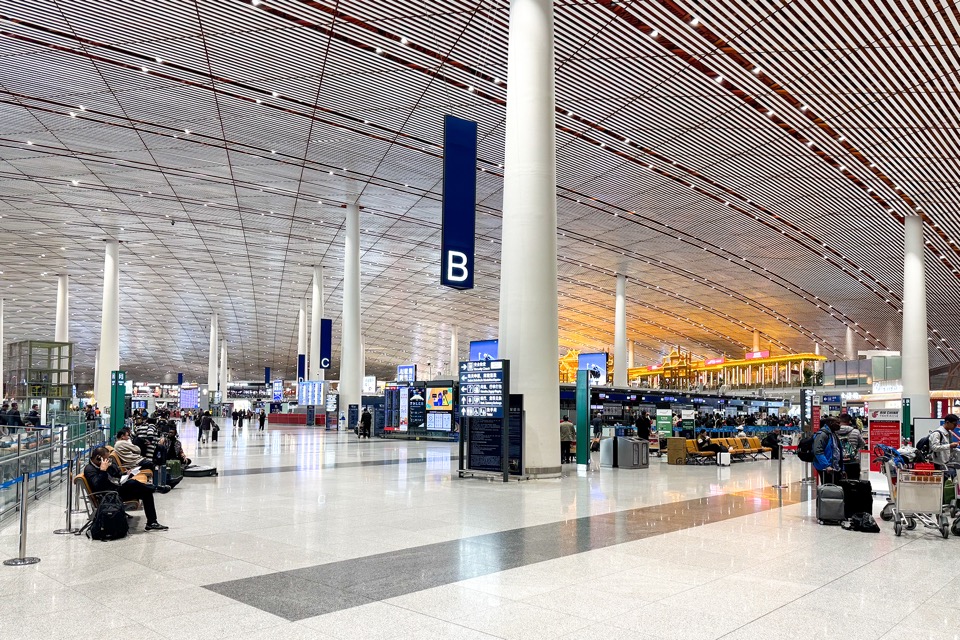
The whole airport routine is three stops, and the first one is the one travelers miss. Before you check in any bag that holds refund goods — or carry them through with you — find the customs verification counter for departure tax refunds and present the goods, the application forms, the invoices and your passport. Customs stamps the forms; without the stamp there is no refund.
Only after clearing security and exit immigration do you go to the refund agency counter inside the restricted area, hand over the stamped forms and collect the money. For a standard refund, shopping in one city and flying out of another is fine — the money is always paid at your actual departure port. Refund-on-purchase claims are the exception: those follow the port named in your agreement, unless your region is covered by the mutual-recognition deals described above.
Since 1 July 2026 the customs step is lighter for small claims: application forms under ¥10,000 are randomly sampled for physical inspection instead of checked item by item, and the paperwork can be verified electronically. Beijing Capital T3 has self-service kiosks that pull up all your claims from a passport scan; Shanghai Pudong and Shenzhen's ports run self-service machines too — Shenzhen's can finish a claim in about two minutes.
- Beijing: customs verification in the departure halls of Capital T2 and T3 and Daxing; refund counters inside the restricted area, operated by Bank of China.
- Shanghai: counters after security at Pudong T1 and T2 (open 24 hours), both satellite halls (first to last flight) and Hongqiao T1; Shanghai's tax bureau publishes an English list of every port and its hours.
- Guangzhou: refund desks in the restricted commercial zone of Baiyun T2 and T3, 08:00–23:00.
- Shenzhen: self-service refund machines at six ports including Bao'an airport and the Luohu land crossing.
- Land borders are in the scheme now too — the Hekou crossing to Vietnam from 1 July 2026, and the Hong Kong–Zhuhai–Macao Bridge and Hengqin ports from the same date.
- Leave margin: queues at the big airports are real, and a claim of ¥10,000 or more is still inspected item by item.
Getting paid
Refunds are paid in renminbi by cash or bank transfer, and the split is at ¥20,000 of refund — not of spending. At or under ¥20,000 you choose: cash on the spot, or a transfer to a Chinese or overseas account. Above ¥20,000 it must be a transfer, because that is the cash ceiling.
Several cities add faster rails on top of the national options: Alipay and WeChat Pay refunds at some ports, and Shenzhen pioneered a digital-yuan hard-wallet payout. What you get depends on the port, so ask at the counter.
- Cash refunds over ¥20,000 are not possible — if a big claim will come to that, plan on the transfer.
- Transfers to overseas accounts need your bank details including the SWIFT code, and can take longer than a domestic transfer.
- Wallet payouts exist at some ports: Shenzhen takes AlipayHK and WeChat Pay HK, useful for Hong Kong day-trippers.
- The refund calculation is per claim per port; two stamped forms from two stores are usually paid together at one counter.
Hainan is a different scheme entirely
Hainan runs its own offshore duty-free scheme, and travelers routinely confuse the two. It is the only such zone in China, running since April 2011: you buy in a Hainan duty-free store or its approved online window, and the purchase is exempt from customs duty, import VAT and consumption tax — not a VAT refund on goods you later carry out. In practice the stock is imported luxury goods, and you collect at the airport, railway station or ferry terminal.
Foreign travelers are covered. The rules changed around the December 2025 island-wide customs closure: departing visitors on foreign passports now qualify, with purchases counted against the same ¥100,000 annual allowance, unlimited times. Anyone aged 18 or over with a passport and an onward ticket out of Hainan can use it — mainland residents can too, which is the sharpest difference from the departure tax refund.
Two things follow from having two schemes. Goods bought in a duty-free store cannot then be claimed under the departure tax refund — that is the exclusion listed above, and it is why the two never stack. And one category is closed to you if you are leaving China from Hainan: gold, silver and other precious-metal items are sold duty-free only to travelers who leave the island without leaving the country.
- Allowance: ¥100,000 per person per year, unlimited trips, across 47 product categories.
- Quantity caps per purchase: 30 cosmetics items, 4 phones, 1,500ml of alcohol in total, 2 micro drones. Anything beyond the allowance or caps is taxed as a normal import.
- Collection options: pick-up in the port restricted area, mail delivery, pick-up on return to the island, buy-and-take-now, or a deposit-backed pick-up.
- Rule of thumb: imported luxury goods at Hainan's duty-free stores use the allowance; Chinese-made goods bought anywhere on the mainland use the ¥200 refund route described above.
Where the advice you have read is out of date
Half of what ranks well on this topic was written before the 2025 reform or the July 2026 update, and the errors are consistent enough to list. The threshold is ¥200 per store per day, not the ¥500 that dominated search results for a decade. Paper application forms are no longer strictly required — since 1 July 2026 customs and agencies can process claims electronically — though you should still take the form and invoice from the store as your proof.
Two more: the refund is paid in renminbi, not converted to your home currency at the counter; and the popular claim that you can only get the money at the airport where you shopped has never been true — the refund is paid wherever you leave the country, including cruise terminals and land borders.
- "Global Blue counters" in search results: China's port refunds are handled by designated agencies, several of them bank branches — check the sign and the official port list rather than a brand name.
- A ¥500 minimum is the old rule. A ¥250 teapot qualifies today.
- Used the item, lost the packaging, or the goods went into a bag you already checked in? That claim is effectively dead — the airport routine only works in that order.
Questions travelers ask
Can I claim if I fly out of a different city than where I shopped?
Yes. The refund is always paid at your actual departure port, wherever the goods were bought — Beijing shopping and a Shanghai departure is a normal case. The customs verification and the refund counter both happen at the departure port.
Is the refund really worth it on small purchases?
At roughly 8–9% net, a ¥300 purchase returns around ¥25. The threshold is ¥200 per store per day, so everyday shopping qualifies — but the airport effort is the same for one form or five, so consolidating purchases into fewer store visits per day is the efficient move.
What if customs selects my form for inspection?
Claims under ¥10,000 are randomly sampled since 1 July 2026, and claims of ¥10,000 or more are inspected every time. Inspection means opening the goods with an officer, so keep purchases accessible and unopened, and do not seal or gift-wrap them before flying.
I used the item or threw away the box. Can I still claim?
No. The goods must be unused and carried out of China, and customs verifies them physically when sampled or when the claim is over ¥10,000. Buy, keep, claim, and only then use — the order cannot be reversed.
Does Hainan's duty-free shopping replace the departure tax refund?
No — they are separate schemes that cannot be combined. Hainan's offshore duty-free scheme exempts imported goods from customs duty, import VAT and consumption tax up to a ¥100,000 annual allowance, and foreign passport holders can use it. The departure tax refund returns VAT on goods bought at registered stores on the mainland, from ¥200 upwards. A duty-free purchase in Hainan cannot then be claimed as a refund.
Do Hong Kong, Macao and Taiwan residents qualify?
Yes — the scheme covers foreign nationals and residents of Hong Kong, Macao and Taiwan of China who have stayed in the mainland no more than 183 consecutive days, using their travel permits or passports as ID.
Can I get the refund in cash, and is there a limit?
Yes, in renminbi. Refunds of ¥20,000 or less can be paid in cash or by transfer, your choice; above ¥20,000 it must be a bank transfer. Some ports also pay out through Alipay, WeChat Pay or a digital-yuan wallet.