
Watching a rocket launch from a Hainan beach
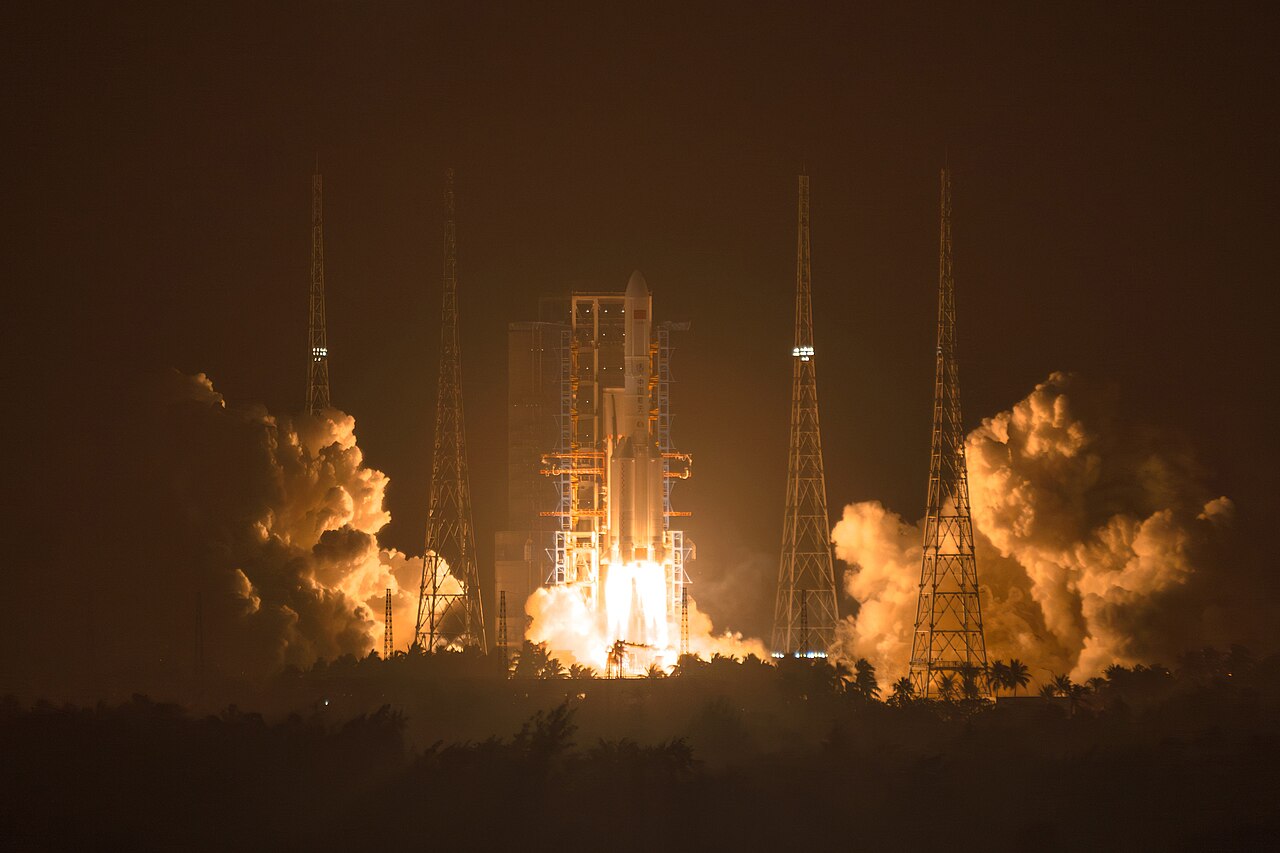
At Wenchang, on Hainan's northeast coast, orbital rockets leave the pad a few kilometres from a public beach, and anyone can stand on it: no ticket, no gate, no registration. Getting there is easy. Knowing when to be there is the entire problem — here is how a launch date actually surfaces, where to stand, and which rule will get you into real trouble.
The hard part is the date, not the journey
China does not publish a launch calendar. Two days before the Chang'e-7 Moon probe was due to fly in August 2026, the official line from the China Manned Space Agency was that it would launch at an appropriate time. That is the standard formula and it means what it says: the rocket had already been rolled out to the pad, and there was still no public date.
What surfaces instead are the side effects. In the days before a launch, Wenchang's city government declares a temporary restricted airspace over the whole municipality. Hainan's maritime authority publishes navigation warnings closing the sea areas where spent stages come down. The traffic police announce road closures around Longlou. Each notice carries a date and a time window, and together they are the schedule — published a few days out, not a few weeks.
English-language launch trackers read those same notices and turn them into a date and a window, usually within hours of publication. They are the practical answer for anyone not reading Chinese, and they are not official. Treat any date more than a week out as an estimate, and expect it to move.
Worth knowing. Do not build a trip around a launch date. Build a trip to Hainan and let a launch land inside it. In the first three weeks of August 2026 there were three: a Long March 7A on the 10th, a Long March 12 from the commercial pad on the 16th, and Chang'e-7 pencilled in for around the 24th. A week on the island in a busy stretch gives you a real chance. A weekend booked six weeks ahead is a coin flip.
There are two launch sites, not one
Both sit in Longlou, on the coast northeast of Wenchang town, and both fire out over the same water.
- The Wenchang Space Launch Site is the national one — the coastal pad built for the wide-bodied rockets. The Long March 5 that carries Moon missions flies from here, and so did the Long March 7A that failed in August 2026.
- The Hainan Commercial Space Launch Site is a separate, newer facility next door with its own pads, flying commercial and constellation missions. The Long March 12 that put up a batch of internet satellites on 16 August 2026 went from its Pad 2.
The distinction matters for one reason only: when a paid viewing platform advertises a distance to "the launch site", ask which one. The two are a few kilometres apart, and a platform close to the commercial pads is not close to the national ones.
Where to stand
Qishui Bay beach is the answer for most people. It is open public sand a few kilometres down the coast from the national pads, with nothing between you and the sea. It is where the television crews set up, and it is where the crowd goes — thousands of people on a significant launch, phones up, the whole beach counting down. There is no ticket, no gate and no registration. You walk on.
Other free spots along the Longlou coast get named locally, but no official list of them is published. Ask wherever you are staying rather than trusting a blog.
The paid option is a roof. Wenchang licenses rooftop viewing on buildings in the area, and the city's own safety standard for these sites is unusually blunt about what you are buying: watching a launch is a free public activity, and the operator may only charge for the service wrapped around it, at a posted price. The same standard caps density at one person per 1.5 square metres, requires railings at least 1.5 metres high on all four sides, and requires operators to register every visitor by name.
Arrive hours early, not minutes. Roads into Longlou close before the window, parking near the beach is limited, and the crowd forms long before anything happens.
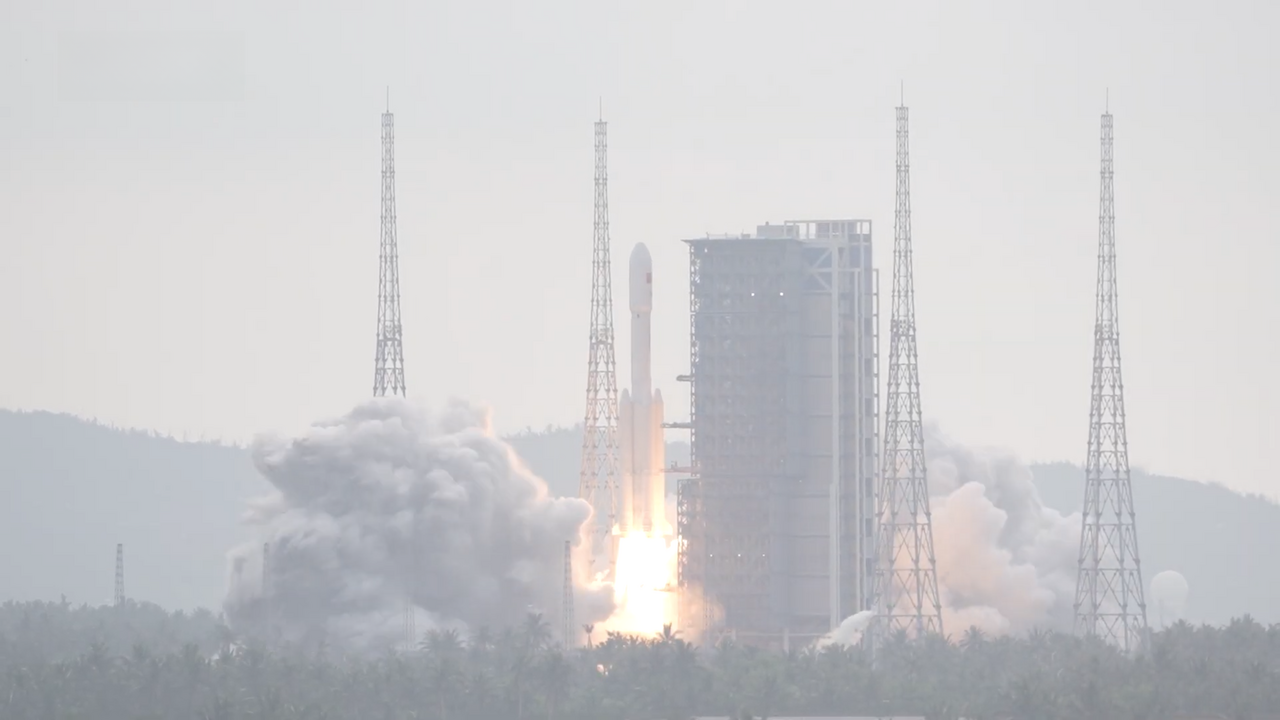
There is no "inside the base" ticket. Wenchang's rules for the space-tourism trade specifically ban operators from advertising 内场观礼 ("inside-the-venue viewing") or "VIP internal tickets" — a rule that exists because they were being sold. Nothing legally on sale puts you inside the launch complex. The same rules put launch-period hotel rooms under a government guidance price and forbid unmarked surcharges.
Getting there
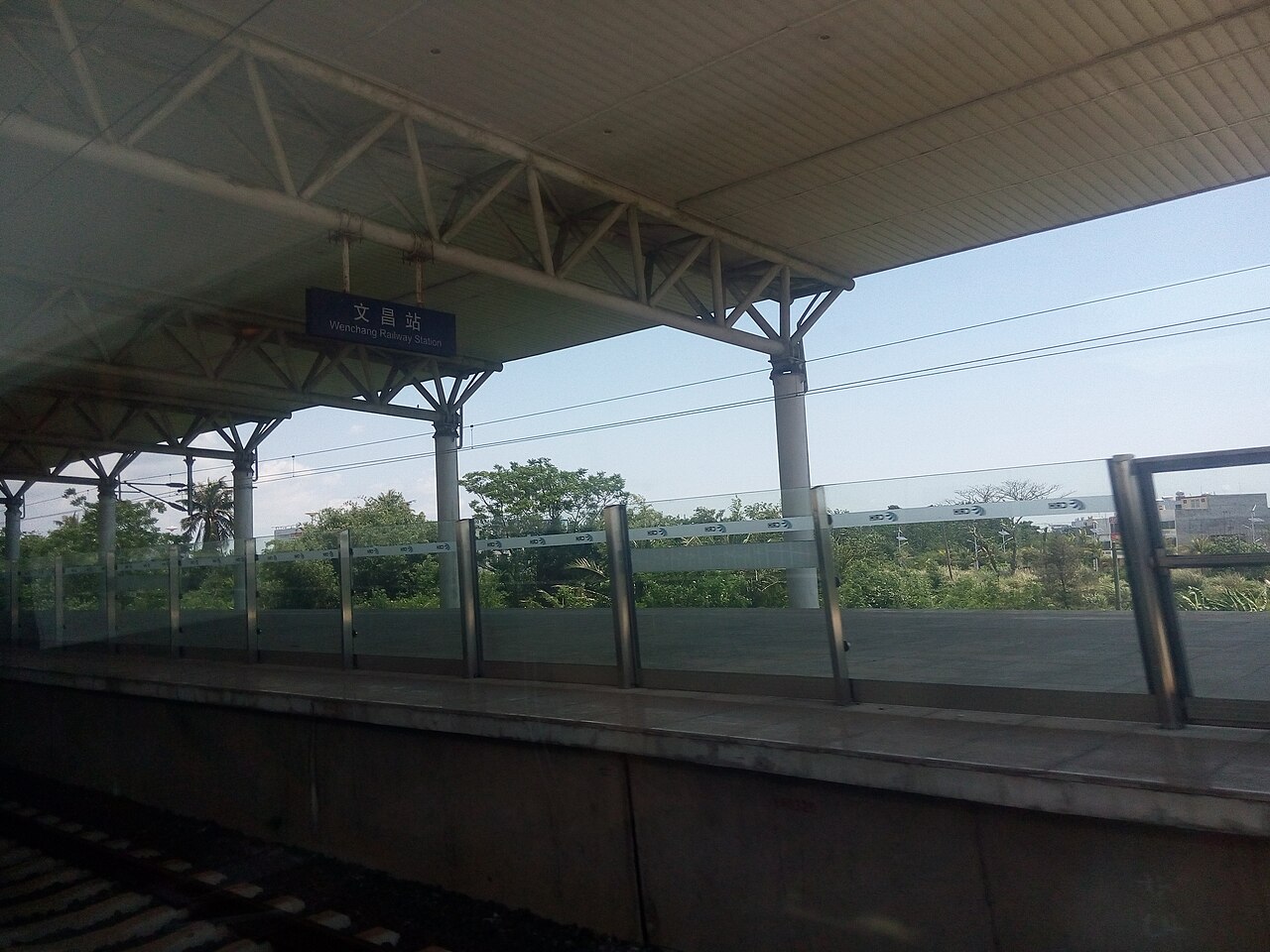
Fly into Haikou Meilan (HAK). The airport has its own station on the Hainan eastern ring high-speed railway — about 400 metres, five minutes on foot from either terminal — and Wenchang is the next station up the line. Coming from the city instead, Wenchang is two stops out from Haikou East; the airport is nine minutes from Haikou East, which tells you the scale of the island's distances. The station's ticket machines run in English and take cash, UnionPay, Alipay and WeChat Pay, but booking ahead with your passport is still the sane approach: see booking 12306 as a foreigner.
Wenchang town is not the launch site. The pads are out at Longlou, a further drive northeast. On launch days the city has run dedicated shuttle lines from Wenchang's high-speed rail station and its bus station out to Longlou — nine yuan when the scheme was announced in 2024 — along with park-and-ride from temporary car parks outside the town. These are launch-day measures rather than a standing timetable, so confirm on the day rather than planning around them.
Leave the drone at home
This is the rule most likely to get a visitor into real trouble, and it is not a formality. Around each launch, Wenchang declares a temporary restricted zone covering the entire municipality, with tighter prohibitions in the three coastal townships of Longlou, Dongjiao and Wenjiao. The banned list is long and deliberately exhaustive: drones, model aircraft, light and ultralight aircraft, light helicopters, gliders, hang gliders and powered hang gliders, paragliders and powered paragliders, hot-air balloons, airships, tethered balloons and free-floating balloons. Flying any of them — taking off, landing or in the air — is prohibited for the duration.
The notice is published as a numbered city government document days in advance, with exact start and end times. Ordinary photography from the public beaches is a different matter and is not restricted: the sand is full of phones and long lenses, and state broadcasters film from the same spot. The launch base itself is a working, guarded facility. Stay on the public side of every fence and sign, and do not treat a quiet perimeter road as an invitation.
Carry your passport, and expect to hand it over
Paid rooftop platforms are required to register visitors by name. Chinese buyers do this with a national ID number, which is the point where a foreign visitor's booking sometimes stalls: as of August 2026 there is no official statement on whether every operator's booking system accepts a passport number in that field.
The practical shape of this: carry your passport, expect to be asked for it, and treat the free beaches as the reliable plan rather than the fallback. They need nothing from you.
It might not fly, and it might not work
On the evening of 10 August 2026 a Long March 7A carrying the ChinaSat 4B communications satellite lifted off from Wenchang, and broke up roughly 85 seconds into flight. From the beach the break-up read as part of the spectacle; the failure was confirmed publicly some hours later. It was China's fourth launch failure of the year.
Failures are the rare case. The common case is duller and more likely to affect you: weather slips the window, the window slips a day, and "an appropriate time" turns out to be next week. Plan for a scrub. If the launch has to justify the trip, the trip is badly built.
Entry, and one rule specific to Hainan
Most visitors now arrive under China's nationwide visa-free entry — check whether your passport is covered in visa-free eligibility. Hainan separately runs its own regional scheme: the National Immigration Administration lists around sixty nationalities who may enter Hainan without a visa and stay up to 30 days for tourism, business, visits, medical treatment, conferences and sport — work and study excluded.
The catch is in the wording of that policy. The permitted area of activity is Hainan province, and you must enter and leave through a Hainan port. It gets you to the beach at Qishui Bay. It does not get you to Beijing.
Everything else is ordinary China travel: your accommodation registers you within 24 hours (the 24-hour rule), and a foreign card linked to Alipay or WeChat Pay handles payment (how foreigners pay in China).
Sources
- Wenchang Municipal Government — 《文昌市航天发射观赏点安全服务规范》(viewing-point safety and service standard), issued 24 July 2024. wenchang.hainan.gov.cn
- Wenchang Municipal Government — 《文昌市规范航天旅游市场秩序管理办法》(space-tourism market rules), issued 24 July 2024, effective 26 August 2024. wenchang.hainan.gov.cn
- Wenchang Municipal Government — temporary ban on small aircraft and airborne objects, 文府函〔2025〕750号, 27 December 2025. wenchang.hainan.gov.cn
- Hainan Provincial Government — launch-period shuttle lines and park-and-ride, 28 June 2024. hainan.gov.cn
- Hainan Maritime Safety Administration — navigation warnings. hn.msa.gov.cn
- Haikou Meilan International Airport — intra-city train and high-speed railway: station list, walking distance, ticketing. mlairport.com/mljcen/railway/
- National Immigration Administration — regional visa-free entry policies (Hainan). nia.gov.cn